
When a Brass Band Shows Up, People Breathe Again
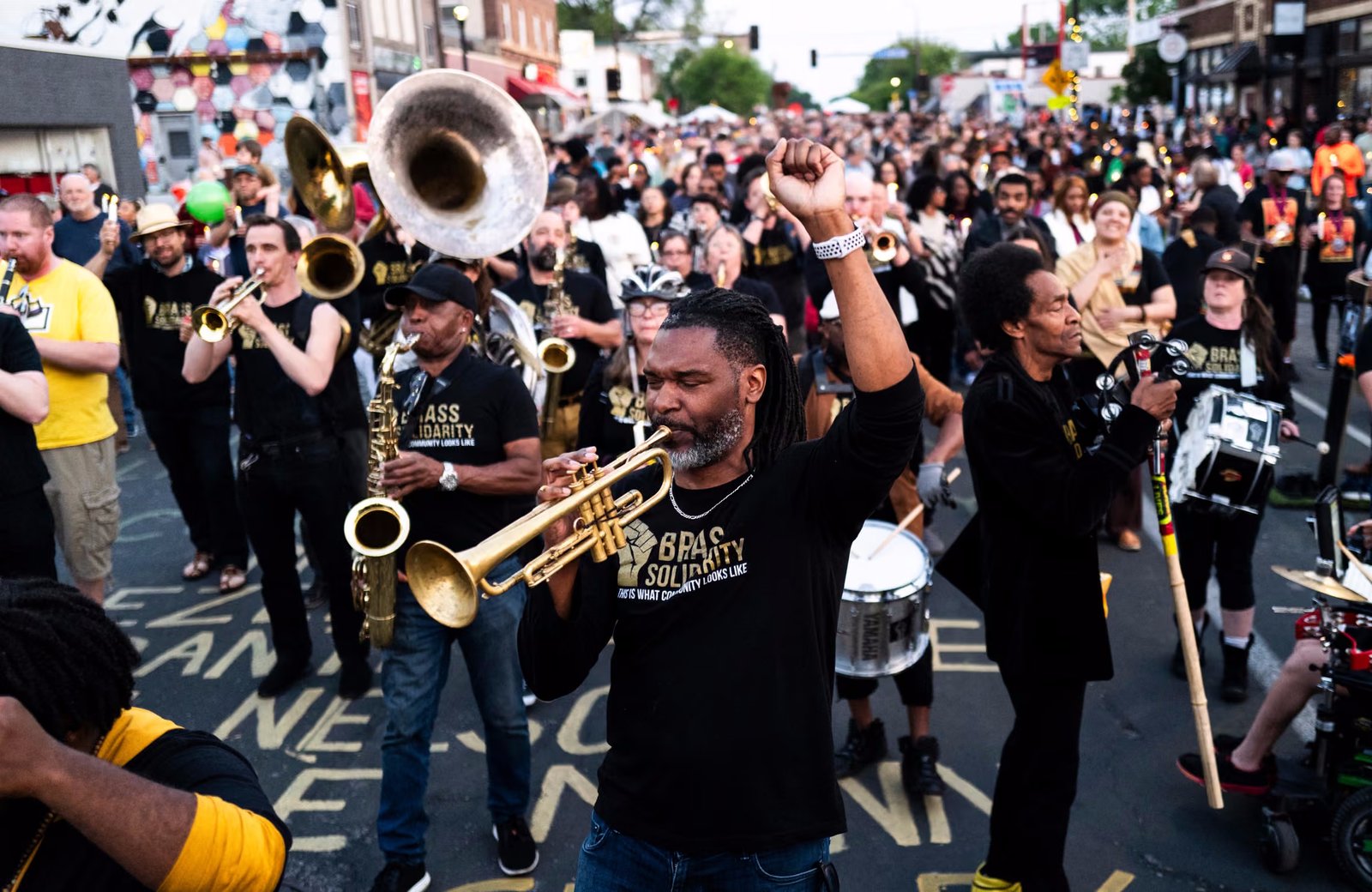
On a cold afternoon, a brass band gathers on a sidewalk. No stage. No ticket booth. No announcement. Just a few musicians lifting horns and starting to play. People slow down. Some stop. Some cry. Some stand quietly, unsure what they’re feeling but relieved that someone has made a sound in a moment that otherwise feels unspeakable.
That’s the setting described in this recent report about a Minneapolis group playing in public spaces to create connection and hope after traumatic events in the city. The musicians call themselves a solidarity band, and their purpose isn’t performance in the traditional sense. It’s presence. They show up where people are grieving or anxious, and they make music that allows a crowd to breathe together again.
Read the full piece here:
https://www.theguardian.com/us-news/2026/feb/14/minneapolis-brass-solidarity-band-ice
What’s striking isn’t just that they play. It’s where they play: outside memorials, near protests, in spaces where people feel unsure about gathering but need to. In those places, music becomes a social permission structure. It allows strangers to stand near one another without needing a script. No one has to make a speech. No one has to know the right words. The music does the work of holding the moment.
This idea isn’t new. New Orleans has long understood that brass bands function as community infrastructure as much as entertainment. The tradition of second-line parades—where a band moves through public space and people follow, dance, and grieve together—has always been about collective processing as much as celebration.
More on that lineage here:
https://www.smithsonianmag.com/arts-culture/new-orleans-second-line-parades-180959484/
When a brass band plays in public, it creates a temporary commons. The rules are simple: listen, walk, stand, sway. Even people who don’t think of themselves as “music people” understand how to be there. The Minneapolis musicians in the article talk about this directly. They don’t require auditions. They don’t curate a perfect sound. They show up and play songs people can recognize or feel immediately. The goal is connection, not virtuosity.
There’s something important in that choice. In professional music culture, we often spend years refining craft, repertoire, and presentation. But in community moments, polish isn’t the priority. Responsiveness is. A slightly rough ensemble that appears at the right time can be more powerful than a flawless concert that never happens. The value lies in immediacy and presence.
Organizations like Brass Bands for Social Justice and other community-music initiatives have been exploring this idea for years: music as civic participation rather than just artistic output.
An overview of community-based music initiatives can be found here:
https://nafme.org/blog/lets-go-go-music-community-and-social-responsibilities/
In Minneapolis, the band members describe their work as a form of emotional support. They’re not therapists. They’re not officials. But they’re offering a container where people can stand together and feel less alone. In moments of civic tension or grief, that matters. Music becomes a shared language when spoken language feels loaded or inadequate.
This kind of ensemble also changes the relationship between musicians and the public. Instead of performing for an audience, they perform with a community. The line between player and listener blurs. Someone might join on a tambourine. Someone might hum. Someone might just stand quietly. Participation doesn’t require musical training. It requires willingness to be present.
There’s a lesson here for any musician who works in community spaces. We often think of concerts as the primary way music reaches people. But informal, responsive gatherings may have equal or greater impact. A band that can move—literally and figuratively—into public life can help shape how a city processes events and supports one another.
The Minneapolis group isn’t trying to solve political problems. They’re not issuing statements. They’re playing songs. And in doing so, they create a moment where people can gather without needing to agree on everything else. That’s a modest goal, but a meaningful one. Music doesn’t erase conflict or grief, but it can make those experiences less isolating.
There’s research suggesting that group music-making synchronizes breathing and heart rates among participants, fostering a sense of unity and calm. Even passive listening in a shared space can have similar effects.
A useful overview of music and collective wellbeing is here:
https://www.apa.org/monitor/nov01/music
But you don’t need a study to feel it. Anyone who has stood in a crowd while a band plays a simple, familiar melody knows the sensation. Shoulders drop. Faces soften. Conversations start. People who arrived alone find themselves standing near others who are also listening.
In that sense, a public brass band is doing something quietly radical. It’s reclaiming shared space without demanding anything from those who enter it. You don’t have to buy a ticket. You don’t have to sign up. You just have to be there.
For musicians, this raises an interesting question: what is our role in the life of a city? Are we entertainers who appear on stages, or participants who help shape communal moments? The answer, of course, can be both. But the Minneapolis example reminds us that music’s social function doesn’t depend on scale or prestige. It depends on willingness to show up.
A few horns. A drum. A handful of players. A sidewalk. Sometimes that’s enough.
And when it happens, even briefly, people remember what it feels like to stand together and listen.